I recently had the opportunity to read some interesting Latin American short stories; The Gospel According to Mark, If You Touch my Heart, and A Old Man with Enormous Wings: A Children's Story. These stories all had traditionally Gothic elements such as oppression, decay, misunderstanding of characters, but what was culturally unique was the introduction of "magical realism."
Magical realism is the style of writing that allows familiar things to feel strange and strange things to feel familiar. In The Gospel According to Mark, the Gutres family after listening to Espinosa read the book of Mark, believe that it is their responsibility to conduct a reenactment of the sacrifice of Jesus, with Espinosa playing the part of Jesus. As followers of Jesus that believe it okay to make this sacrifice thinking that the bible says that they would be forgiven. This bizarre behavior is strange but it is happening in the story which has pulled you in to its disbelief.
In If You Touch My Heart, a girl is held captive in a dark dank cellar of an abandon mill for decades. She is so neglected that she start to decay and becomes a part of the actual earth, with lichen, bushes and silkworms growing on her body. Although she is being abused she has no knowledge of this neglect. Even though we hear about abduction all the time the description of the events are not vividly drawn as in magical realism.
Magical realism makes us examine ourselves in A Old Man with Enormous Wings, a story about a fallen angel. The angel is not what we would expect an angel to look like; old, bald, toothless and missing feathers. The people of the community only wanted to use the angel for personal gain. The Priest wanted the angel to prove that he indeed was an angel, which in the Priest eyes the angel had failed to do. It is ironically called a child's story because it is filled with lessons; don't judge a book by its cover, respect everyone, and to remember that we are all imperfect and that we should always show humility.
Magical realism gives the ability to see things that generally go on notices as special, and realize that the thing that we regard as special may not be as special as we believe. This is what is culturally unique about the Latin American Gothic Stories.
Sunday, March 31, 2013

Sunday, March 17, 2013
Western or Japanese? Howl's Moving Castle
Howl's Moving Castle, is a
delightful animated movie by Miyazaki. There is lot of supernatural events
occurring, decay, dark corridors, secret identities, curses, oppression and
romance. These element of goth are familiar to both the Western and the Japanese.
However what is different is how some of the trope are interpreted by the
Japanese.
Traditionally in Western Gothic
oppression is usually expressed by a man's hold over a woman, but in Japan the
transgressor is most often a woman, so in the movie there are multiple women
oppressors. Sophie oppresses her self initially, by tying herself to a business
because due to family obligation, which is also a subtle Japanese trope;
that of obligation. Sophie is later the transgressive woman when she invites
herself to stay at the castle as the housekeeper. Although, Sophie's oppression
turns out to be a gift to all that live in the Castle. However, there are two
other women that are witches who are not as good, the Witch of the Waste and Madame Seville.
The Witch of the Waste has cast a spell on Sophie, which actually liberates Sophie from her self made imprison, of the hat shop. Madame Seville is
the true villain in the movie, attempting to control everyone and everything.
She is the cause of the war that is taking place, by turning the Prince in to a
scarecrow, which everyone thinks was a kidnap by the other warring kingdom. Which starting a war in Western culture is usually the male role in fiction, if not in
history.
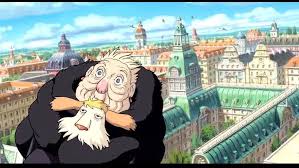
The secret identities of the males in
the story are a mix of both cultures. The Prince as the scarecrow gives you a
like bit of Oz and Howl in his dark monster bird form gives you a little Beauty
and the Beast which I believe is so Disney, Western. Then you have Calcifer and
Howl's bond although supernatural it is Japanese, a pure love of two men that
are obligated to one another, subtle so some westerns may not get it.
I believe that another thing that
some viewer of the west may not get is how the emotion of the character affect
the physical features of the characters. Like when Howl is losing it because he
has lost his beauty he begin to melt or decay into a be puddle of slime or how
Sophie is morphing back forth from old to young depending on her mood. Or the emotion that is demonstrated regarding the war that is taking place in the kingdom, how Miyazaki's characters protest war. This bombing of house is Japanese, having experienced this type of warfare to their country.
I believe also what was Japanese is the self sacrifice that Howl exhibits when he is in his bird form. Knowing the he could possibly lose his human form if he stays in his bird form for to long he continues to go out to fight the evil that is propelling the war, it is reminiscent of the Kamikaze during WWII that would use themselves and their planes as human torpedoes.
Howl's Moving Castle is romantic and it give us Westerns our happy ever after ending, the heroin gets the boy, and they all go off with their new make shaft family. This film has so many twist and turns
to speak of I could go on for awhile, I suggest viewing it. It is a film
appropriate for the whole family. This movie is great and beautiful, and I am
looking forward to adding it to my collection.
Wednesday, March 13, 2013
Howl's Moving Castle
"If you liked the book don't watch the film" according to "Poisonedcherries," who has some strong feeling about the movie. "Poisonedcherries," was very disappointed that the movie didn't follow the book closely enough. She love Calcifer, but was repulsed by the Witch of the waste. She admits the there were funny parts, but can't understand how a book so great can translate into such an awful film. Although, fortunately for me I've never read the book so I found the movie quite delightful.
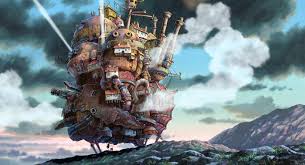
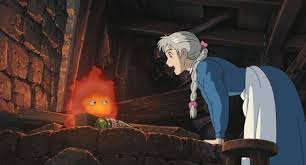
Calcifer I must agree with "Poisonedcherries" is
 awesome, he is the heart and soul of both Howl and the castle. Calcifer is what keeps everything running.
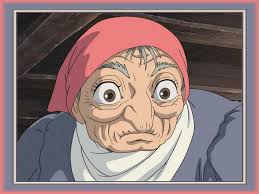
 I love how Sophie once a young, innocent, introvert, with a since of duty to her family is turned into a old, speak you mind, bossy, grandma type with a since of duty to her friends. Although, the Witch of the Waste was horrific to look at, and evil after having her heart broken by Howl, she later turns into just a sweet old lady who is still in love with Howl.
I also love how the story didn't have a typical happily ever-after ending the Disney usually provides. It did have one but Sophie had two males that believe her to be his true love. The scarecrow or Turniphead as Sophie called him. He and Howl, each are Sophie's protectors. Although, Turniphead may have had a motive for taking such good care of Sophie, like the traditional Disney true loves kiss. I must say that he was loyal to Sophie long before he knew that she wasn't really an old woman. Turniphead got his kiss, but not the girl. That was to be Howls reward.
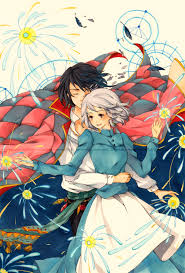
 Howl did not only receive the reward of Sophie but also the reward of courage. Howl believed that he was nothing if not beautiful. So yeah he was a bit narcissistic, being in love with himself and all, but Sophie helped him become a better man, one of internal strength to match his external strength. So he no longer has to run, he has a heart of fire and his Sophie and they live happily ever after.
So I don't agree with "Poisonedcherries" about the film, but I don't understand how one may feel let down if their favorite book isn't present in a light which one was expecting, oh well "Poisonedcherries" get over it. Better Luck next time, but for anyone who hasn't read the book give it a viewing and if you have read the book, take a look and decide for yourself.
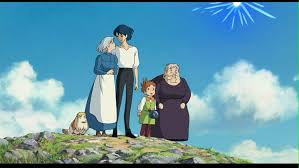
Calcifer I must agree with "Poisonedcherries" is
I also love how the story didn't have a typical happily ever-after ending the Disney usually provides. It did have one but Sophie had two males that believe her to be his true love. The scarecrow or Turniphead as Sophie called him. He and Howl, each are Sophie's protectors. Although, Turniphead may have had a motive for taking such good care of Sophie, like the traditional Disney true loves kiss. I must say that he was loyal to Sophie long before he knew that she wasn't really an old woman. Turniphead got his kiss, but not the girl. That was to be Howls reward.
So I don't agree with "Poisonedcherries" about the film, but I don't understand how one may feel let down if their favorite book isn't present in a light which one was expecting, oh well "Poisonedcherries" get over it. Better Luck next time, but for anyone who hasn't read the book give it a viewing and if you have read the book, take a look and decide for yourself.
Monday, March 11, 2013
Japanese Gothic Literature
After spending a great deal of time of European Gothic literature I have had the opportunity to experience some of the Japanese Gothic literature. What I have found is that the both have similar themes, but are expressed differently. Oppression in the European Gothic is generally a man oppressing a woman or women, as in The Castle of Otranto, Manfred was the oppressor of his wife, daughter and dead son's fiance. However, In the Japanese Gothic the oppressor is often a woman, as in The Tatooer, the young geisha becomes the tormentor of men, beginning with the tatooer as her first victim, even though he is who has helped her unveil her true self.
Another theme is the supernatural, this is presented in most Western Gothic, the living portrait in The Castle of Otranto and the zombie sister in "The Fall of the House of Usher." These supernatural events were signs or punishment for the acts of the living. Well in the Japanese Gothic you have these types of events but it is usually due to something that the dead has done, a pledge unfulfilled as in "The Chrysanthemum Vow," Saomon returns as a ghost to fulfill his pledge to Samon.
Now that I have seen Gothic through the lens of a different culture I can see that the themes are similar but the interpretation is different. The Western and the Japanese Gothic literature both have the emotional intensity, but while I was reading The Surgery Room it touched me very deeply I could really feel the couples sorrow. So I guess in some ways I feel as though the Japanese are a little more intense, which I think is due to our culture differences.
Another theme is the supernatural, this is presented in most Western Gothic, the living portrait in The Castle of Otranto and the zombie sister in "The Fall of the House of Usher." These supernatural events were signs or punishment for the acts of the living. Well in the Japanese Gothic you have these types of events but it is usually due to something that the dead has done, a pledge unfulfilled as in "The Chrysanthemum Vow," Saomon returns as a ghost to fulfill his pledge to Samon.
Now that I have seen Gothic through the lens of a different culture I can see that the themes are similar but the interpretation is different. The Western and the Japanese Gothic literature both have the emotional intensity, but while I was reading The Surgery Room it touched me very deeply I could really feel the couples sorrow. So I guess in some ways I feel as though the Japanese are a little more intense, which I think is due to our culture differences.
Monday, March 4, 2013
Graphic Novel
The graphic Gothic novel brings an intensity to the novel that is not seen in the traditional Gothic novel. In Niel Gaiman Sandman the visual panels pull you deeper into the story by giving you Gaiman's idea of what is creepy or not so creepy. Like in "Imperfect Host" he showed the gargoyles as sweet little household pets, the one could have been a Great Dane and the other any sweet little puppy, but not the creepy or scary gargoyles that sit atop buildings, ironic right?
Sunday, March 3, 2013
Sandman Response
The creepiest page was in "Dream a Little Dream of Me" when they discover Rachel in the bed naked. She is
naked and her skin appears to have sore all over it, her hair is falling out and she looks like an addict. Which is
creepy to me because I can see the connection to her addiction to drugs and her addiction to the sand. When
John last saw her she was a drug addict and he now see her dependent on the sand for dreams. Rachel talks
about all she has to do is dream, and she has a hand filled with sand and when Dream takes back his bag of sand
she talks about how it hurts. She needs the sand to stay alive, to live, to easy the pain this is the behavior of an
addict. I found it interesting how Gaiman combined these two world into one world of abuse. It made be think
that anything can be an addiction and any addiction can destroy your life, which is why I thought it was creepy.
The power of the sand and Dream where both supernatural which makes this a Gothic story and not horror.
There is also elements of decay; the smell of the house and Rachel's bedroom, and Rachel herself is decaying.
The supernatural ability of the dreams on the walls that after Constantine touches it, he goes into a dream about
falling to his death. John is saved by the supernatural control that Dream has over all dreams.
The Sandman series are very interesting and I can see how people become addicted to them.
naked and her skin appears to have sore all over it, her hair is falling out and she looks like an addict. Which is
creepy to me because I can see the connection to her addiction to drugs and her addiction to the sand. When
John last saw her she was a drug addict and he now see her dependent on the sand for dreams. Rachel talks
about all she has to do is dream, and she has a hand filled with sand and when Dream takes back his bag of sand
she talks about how it hurts. She needs the sand to stay alive, to live, to easy the pain this is the behavior of an
addict. I found it interesting how Gaiman combined these two world into one world of abuse. It made be think
that anything can be an addiction and any addiction can destroy your life, which is why I thought it was creepy.
The power of the sand and Dream where both supernatural which makes this a Gothic story and not horror.
There is also elements of decay; the smell of the house and Rachel's bedroom, and Rachel herself is decaying.
The supernatural ability of the dreams on the walls that after Constantine touches it, he goes into a dream about
falling to his death. John is saved by the supernatural control that Dream has over all dreams.
The Sandman series are very interesting and I can see how people become addicted to them.
Subscribe to:
Comments (Atom)