The Hound of the Baskerville has changed since the original story by Arthur Conan Doyle in the early 1900's. In order to keep the attention of the people in the 21st century it had to be updated to appeal a time period of people who are more sophisticated. Some of the changes made were to evoke fears of the 21st century, there were also personality changes, and some other things changed and some stayed the same. Which I believe may be the change of the definition of 21st Gothic.
I think that one of the larges changes is how science has become the new supernatural. That science is something to fear it is part of the unknown to most of us, because we are not scientist. When the military is doing genetic testing and development on animals and humans. So now the hound of Baskerville is not simply a dog, but a genetically altered dog, and acronym for a group of scientist who had worked of chemical warfare. People worry everyday about what is being developed by the government where is the line drawn between the development for good and evil. There have been events in the passed when experiment have been conducted to unknowing individuals, that is why this line of thinking is frightening to the average person. Along with the science comes the science lab, which in the old text was a castle. However, most of us are not very afraid of castles. Yet being trapped in a science lab, especially where genetic altering is going on is a bit intimidating. The moor is not a place where the supernatural occurs but where you might step on a land mind, not to safe. The updates make this version brings more creep than the earlier ones.
There are also changes to Holmes and Watson. Holmes is clearly a man of genius, he appears to be a person with high functioning aspergers or some other disorder under the autisms umbrella spectrum. He is more sensitive to how his behavior effects Watson. Even though he still does things in the name of discovery. Like when he locks Watson in the lab and turns out the lights and makes hound noises to scare Watson, in the name of science, because science is scary. He hurts Watson feelings by saying that he has no friends and later explains that he only has one, we like the bromance in movies these days, which if you think about it, it is a bit Japanese. Holmes is younger, cuter, and cooler than in the past. With his black hero coat. Watson on the other hand is a lot different in the way he challenges Holmes, the old Watson would have just followed Holmes' lead. Watson is more of a free thinker not just an obedient servant of the past. He is really laid back and casual. Which allows him to help balance the act of the Holmes/Watson dual.
Here are some character that have changed in one way or another. Henry is still haunted by the hound of the Baskerville, but it is not a family curse. Dr. Mortimer is still Henry's doctor, but is a beautiful woman. Barrymore still works at Baskerville but is a general not a butler. Stapleton is still studying species but is not a man or the villain. Franklin is still investigating things but he is the villain, trying to cause Henry to have a psychotic break.
So I believe that science is the new supernatural causing the fears that were once presented by the unknown of the supernatural. There are so many things that are still a mystery to us that may be supernatural, which scienctist are searching for the answers to everyday. There are things done in the name of science that many take issue with due to the method in which the testing or discoveries are handled. So yes what was scary in the past is not the same as what strikes fear in the 21st century, yes Gothic is changing.
Monday, April 15, 2013

Sunday, April 7, 2013
Holmes vs. Watson

In The Hound of the Baskerville, the hound strikes fear in the heart of the Devonshire residents and the Baskerville heirs. Watson narrates the story explaining how he and Holmes both deal with fear. Holmes' relationship with fear is not that of the average person, but Watson's fear is common placed. Holmes believes that fear is no more than an obstacle that simply needs to be analyzed in order to eliminate it.
Holmes knowing the curse of the Baskerville pretends that it truly may be something supernatural, by telling Sir Henry to stay away from the moor after dark. Yet, he is living on the moor in one of the decaying stone huts. Holmes is obviously not fearful of a legendary supernatural hound that is said to reside on the moor. Watson on the other hand claims not to be afraid of the superstition of the moor, but when he hear the howling of the unknown it chills him.
Both Holmes and Watson are men of action. Even when Watson knows that there is a reason for fear he approaches it. Watson attaches fear without thinking it through, a good example is when he finds the lair of the mysterious man of the moor. He enters the hut not knowing what he may encounter, fortunately it was only Holmes. Holmes on the other hand is very observant and thinks everything through and devises a plan. A great example of this is when Watson wants to charge in and take Stapleton, but Holmes explains that they must have evidence otherwise Stapleton will know that they are on to him.
Although Watson is a charge through your fears and ask questions later kind of guy and Holmes is a work out the puzzle to eliminate fear type of guy the work perfectly together, like the two sides of the brain, different functions by needed to make things work.
Sunday, March 31, 2013
Latin American Gothic
I recently had the opportunity to read some interesting Latin American short stories; The Gospel According to Mark, If You Touch my Heart, and A Old Man with Enormous Wings: A Children's Story. These stories all had traditionally Gothic elements such as oppression, decay, misunderstanding of characters, but what was culturally unique was the introduction of "magical realism."
Magical realism is the style of writing that allows familiar things to feel strange and strange things to feel familiar. In The Gospel According to Mark, the Gutres family after listening to Espinosa read the book of Mark, believe that it is their responsibility to conduct a reenactment of the sacrifice of Jesus, with Espinosa playing the part of Jesus. As followers of Jesus that believe it okay to make this sacrifice thinking that the bible says that they would be forgiven. This bizarre behavior is strange but it is happening in the story which has pulled you in to its disbelief.
In If You Touch My Heart, a girl is held captive in a dark dank cellar of an abandon mill for decades. She is so neglected that she start to decay and becomes a part of the actual earth, with lichen, bushes and silkworms growing on her body. Although she is being abused she has no knowledge of this neglect. Even though we hear about abduction all the time the description of the events are not vividly drawn as in magical realism.
Magical realism makes us examine ourselves in A Old Man with Enormous Wings, a story about a fallen angel. The angel is not what we would expect an angel to look like; old, bald, toothless and missing feathers. The people of the community only wanted to use the angel for personal gain. The Priest wanted the angel to prove that he indeed was an angel, which in the Priest eyes the angel had failed to do. It is ironically called a child's story because it is filled with lessons; don't judge a book by its cover, respect everyone, and to remember that we are all imperfect and that we should always show humility.
Magical realism gives the ability to see things that generally go on notices as special, and realize that the thing that we regard as special may not be as special as we believe. This is what is culturally unique about the Latin American Gothic Stories.
Magical realism is the style of writing that allows familiar things to feel strange and strange things to feel familiar. In The Gospel According to Mark, the Gutres family after listening to Espinosa read the book of Mark, believe that it is their responsibility to conduct a reenactment of the sacrifice of Jesus, with Espinosa playing the part of Jesus. As followers of Jesus that believe it okay to make this sacrifice thinking that the bible says that they would be forgiven. This bizarre behavior is strange but it is happening in the story which has pulled you in to its disbelief.
In If You Touch My Heart, a girl is held captive in a dark dank cellar of an abandon mill for decades. She is so neglected that she start to decay and becomes a part of the actual earth, with lichen, bushes and silkworms growing on her body. Although she is being abused she has no knowledge of this neglect. Even though we hear about abduction all the time the description of the events are not vividly drawn as in magical realism.
Magical realism makes us examine ourselves in A Old Man with Enormous Wings, a story about a fallen angel. The angel is not what we would expect an angel to look like; old, bald, toothless and missing feathers. The people of the community only wanted to use the angel for personal gain. The Priest wanted the angel to prove that he indeed was an angel, which in the Priest eyes the angel had failed to do. It is ironically called a child's story because it is filled with lessons; don't judge a book by its cover, respect everyone, and to remember that we are all imperfect and that we should always show humility.
Magical realism gives the ability to see things that generally go on notices as special, and realize that the thing that we regard as special may not be as special as we believe. This is what is culturally unique about the Latin American Gothic Stories.
Sunday, March 17, 2013
Western or Japanese? Howl's Moving Castle
Howl's Moving Castle, is a
delightful animated movie by Miyazaki. There is lot of supernatural events
occurring, decay, dark corridors, secret identities, curses, oppression and
romance. These element of goth are familiar to both the Western and the Japanese.
However what is different is how some of the trope are interpreted by the
Japanese.
Traditionally in Western Gothic
oppression is usually expressed by a man's hold over a woman, but in Japan the
transgressor is most often a woman, so in the movie there are multiple women
oppressors. Sophie oppresses her self initially, by tying herself to a business
because due to family obligation, which is also a subtle Japanese trope;
that of obligation. Sophie is later the transgressive woman when she invites
herself to stay at the castle as the housekeeper. Although, Sophie's oppression
turns out to be a gift to all that live in the Castle. However, there are two
other women that are witches who are not as good, the Witch of the Waste and Madame Seville.
The Witch of the Waste has cast a spell on Sophie, which actually liberates Sophie from her self made imprison, of the hat shop. Madame Seville is
the true villain in the movie, attempting to control everyone and everything.
She is the cause of the war that is taking place, by turning the Prince in to a
scarecrow, which everyone thinks was a kidnap by the other warring kingdom. Which starting a war in Western culture is usually the male role in fiction, if not in
history.
The secret identities of the males in
the story are a mix of both cultures. The Prince as the scarecrow gives you a
like bit of Oz and Howl in his dark monster bird form gives you a little Beauty
and the Beast which I believe is so Disney, Western. Then you have Calcifer and
Howl's bond although supernatural it is Japanese, a pure love of two men that
are obligated to one another, subtle so some westerns may not get it.
I believe that another thing that
some viewer of the west may not get is how the emotion of the character affect
the physical features of the characters. Like when Howl is losing it because he
has lost his beauty he begin to melt or decay into a be puddle of slime or how
Sophie is morphing back forth from old to young depending on her mood. Or the emotion that is demonstrated regarding the war that is taking place in the kingdom, how Miyazaki's characters protest war. This bombing of house is Japanese, having experienced this type of warfare to their country.
I believe also what was Japanese is the self sacrifice that Howl exhibits when he is in his bird form. Knowing the he could possibly lose his human form if he stays in his bird form for to long he continues to go out to fight the evil that is propelling the war, it is reminiscent of the Kamikaze during WWII that would use themselves and their planes as human torpedoes.
Howl's Moving Castle is romantic and it give us Westerns our happy ever after ending, the heroin gets the boy, and they all go off with their new make shaft family. This film has so many twist and turns
to speak of I could go on for awhile, I suggest viewing it. It is a film
appropriate for the whole family. This movie is great and beautiful, and I am
looking forward to adding it to my collection.
Wednesday, March 13, 2013
Howl's Moving Castle
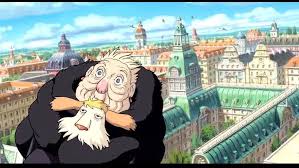
"If you liked the book don't watch the film" according to "Poisonedcherries," who has some strong feeling about the movie. "Poisonedcherries," was very disappointed that the movie didn't follow the book closely enough. She love Calcifer, but was repulsed by the Witch of the waste. She admits the there were funny parts, but can't understand how a book so great can translate into such an awful film. Although, fortunately for me I've never read the book so I found the movie quite delightful.
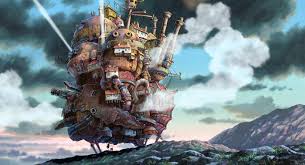
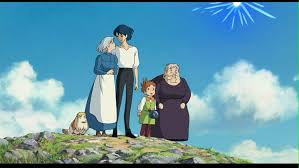
Calcifer I must agree with "Poisonedcherries" is
 awesome, he is the heart and soul of both Howl and the castle. Calcifer is what keeps everything running.
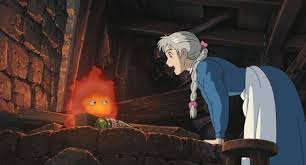
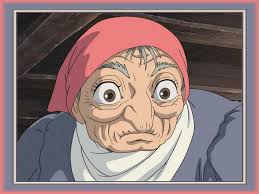
 I love how Sophie once a young, innocent, introvert, with a since of duty to her family is turned into a old, speak you mind, bossy, grandma type with a since of duty to her friends. Although, the Witch of the Waste was horrific to look at, and evil after having her heart broken by Howl, she later turns into just a sweet old lady who is still in love with Howl.
I also love how the story didn't have a typical happily ever-after ending the Disney usually provides. It did have one but Sophie had two males that believe her to be his true love. The scarecrow or Turniphead as Sophie called him. He and Howl, each are Sophie's protectors. Although, Turniphead may have had a motive for taking such good care of Sophie, like the traditional Disney true loves kiss. I must say that he was loyal to Sophie long before he knew that she wasn't really an old woman. Turniphead got his kiss, but not the girl. That was to be Howls reward.
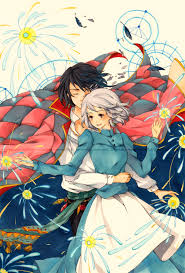
 Howl did not only receive the reward of Sophie but also the reward of courage. Howl believed that he was nothing if not beautiful. So yeah he was a bit narcissistic, being in love with himself and all, but Sophie helped him become a better man, one of internal strength to match his external strength. So he no longer has to run, he has a heart of fire and his Sophie and they live happily ever after.
So I don't agree with "Poisonedcherries" about the film, but I don't understand how one may feel let down if their favorite book isn't present in a light which one was expecting, oh well "Poisonedcherries" get over it. Better Luck next time, but for anyone who hasn't read the book give it a viewing and if you have read the book, take a look and decide for yourself.
Calcifer I must agree with "Poisonedcherries" is
I also love how the story didn't have a typical happily ever-after ending the Disney usually provides. It did have one but Sophie had two males that believe her to be his true love. The scarecrow or Turniphead as Sophie called him. He and Howl, each are Sophie's protectors. Although, Turniphead may have had a motive for taking such good care of Sophie, like the traditional Disney true loves kiss. I must say that he was loyal to Sophie long before he knew that she wasn't really an old woman. Turniphead got his kiss, but not the girl. That was to be Howls reward.
So I don't agree with "Poisonedcherries" about the film, but I don't understand how one may feel let down if their favorite book isn't present in a light which one was expecting, oh well "Poisonedcherries" get over it. Better Luck next time, but for anyone who hasn't read the book give it a viewing and if you have read the book, take a look and decide for yourself.
Monday, March 11, 2013
Japanese Gothic Literature
After spending a great deal of time of European Gothic literature I have had the opportunity to experience some of the Japanese Gothic literature. What I have found is that the both have similar themes, but are expressed differently. Oppression in the European Gothic is generally a man oppressing a woman or women, as in The Castle of Otranto, Manfred was the oppressor of his wife, daughter and dead son's fiance. However, In the Japanese Gothic the oppressor is often a woman, as in The Tatooer, the young geisha becomes the tormentor of men, beginning with the tatooer as her first victim, even though he is who has helped her unveil her true self.
Another theme is the supernatural, this is presented in most Western Gothic, the living portrait in The Castle of Otranto and the zombie sister in "The Fall of the House of Usher." These supernatural events were signs or punishment for the acts of the living. Well in the Japanese Gothic you have these types of events but it is usually due to something that the dead has done, a pledge unfulfilled as in "The Chrysanthemum Vow," Saomon returns as a ghost to fulfill his pledge to Samon.
Now that I have seen Gothic through the lens of a different culture I can see that the themes are similar but the interpretation is different. The Western and the Japanese Gothic literature both have the emotional intensity, but while I was reading The Surgery Room it touched me very deeply I could really feel the couples sorrow. So I guess in some ways I feel as though the Japanese are a little more intense, which I think is due to our culture differences.
Another theme is the supernatural, this is presented in most Western Gothic, the living portrait in The Castle of Otranto and the zombie sister in "The Fall of the House of Usher." These supernatural events were signs or punishment for the acts of the living. Well in the Japanese Gothic you have these types of events but it is usually due to something that the dead has done, a pledge unfulfilled as in "The Chrysanthemum Vow," Saomon returns as a ghost to fulfill his pledge to Samon.
Now that I have seen Gothic through the lens of a different culture I can see that the themes are similar but the interpretation is different. The Western and the Japanese Gothic literature both have the emotional intensity, but while I was reading The Surgery Room it touched me very deeply I could really feel the couples sorrow. So I guess in some ways I feel as though the Japanese are a little more intense, which I think is due to our culture differences.
Monday, March 4, 2013
Graphic Novel
The graphic Gothic novel brings an intensity to the novel that is not seen in the traditional Gothic novel. In Niel Gaiman Sandman the visual panels pull you deeper into the story by giving you Gaiman's idea of what is creepy or not so creepy. Like in "Imperfect Host" he showed the gargoyles as sweet little household pets, the one could have been a Great Dane and the other any sweet little puppy, but not the creepy or scary gargoyles that sit atop buildings, ironic right?
Sunday, March 3, 2013
Sandman Response
The creepiest page was in "Dream a Little Dream of Me" when they discover Rachel in the bed naked. She is
naked and her skin appears to have sore all over it, her hair is falling out and she looks like an addict. Which is
creepy to me because I can see the connection to her addiction to drugs and her addiction to the sand. When
John last saw her she was a drug addict and he now see her dependent on the sand for dreams. Rachel talks
about all she has to do is dream, and she has a hand filled with sand and when Dream takes back his bag of sand
she talks about how it hurts. She needs the sand to stay alive, to live, to easy the pain this is the behavior of an
addict. I found it interesting how Gaiman combined these two world into one world of abuse. It made be think
that anything can be an addiction and any addiction can destroy your life, which is why I thought it was creepy.
The power of the sand and Dream where both supernatural which makes this a Gothic story and not horror.
There is also elements of decay; the smell of the house and Rachel's bedroom, and Rachel herself is decaying.
The supernatural ability of the dreams on the walls that after Constantine touches it, he goes into a dream about
falling to his death. John is saved by the supernatural control that Dream has over all dreams.
The Sandman series are very interesting and I can see how people become addicted to them.
naked and her skin appears to have sore all over it, her hair is falling out and she looks like an addict. Which is
creepy to me because I can see the connection to her addiction to drugs and her addiction to the sand. When
John last saw her she was a drug addict and he now see her dependent on the sand for dreams. Rachel talks
about all she has to do is dream, and she has a hand filled with sand and when Dream takes back his bag of sand
she talks about how it hurts. She needs the sand to stay alive, to live, to easy the pain this is the behavior of an
addict. I found it interesting how Gaiman combined these two world into one world of abuse. It made be think
that anything can be an addiction and any addiction can destroy your life, which is why I thought it was creepy.
The power of the sand and Dream where both supernatural which makes this a Gothic story and not horror.
There is also elements of decay; the smell of the house and Rachel's bedroom, and Rachel herself is decaying.
The supernatural ability of the dreams on the walls that after Constantine touches it, he goes into a dream about
falling to his death. John is saved by the supernatural control that Dream has over all dreams.
The Sandman series are very interesting and I can see how people become addicted to them.
Monday, February 25, 2013
Dana Wise
Professor Benander
World Literature
24 February 2013
“The Adventure of the Speckled Band:” A Gothic Tale? Why?
Gothic can refer to elements as different as architecture, fashion, movies and literatures. Gothic architecture is represented by the pointed roofs, windows and archways; the ornate detailing of the windows archways, and gargoyles. Gothic fashion is represented with clothing that is reminiscent of centuries past mourning garb and make-up that is intense and dramatic. Gothic movie directors like Tim Burton have created a long list of gothic films such as Sweeny Todd, Dark Shadows, and Alice in Wonderland. Clifford J. Kurkowski explains in his essay The Gothic Phenomenon in The Castle of Otranto: A Critical Essay, that “the word Gothic can encompasses a wide range of definitions.” The gothic genre is easier to see with the eye since the aesthetics are more readily identifiable; however, Gothic literature is more difficult. What separates a gothic novel from other novels? How does the reader know when Gothic literature is presented?
Gothic literature is often recognized by the word chosen by the author. If the author presents a decaying building rather than an old house, then it is gothic. If there is a runner headed down a dark and foggy path opposed to a jog through the park, it is surely gothic. If thing are happening that seem mystical or supernatural, such as ghost appearing, moving or aging pictures, then it is a gothic story.
There are many gothic tropes, starting with deep emotional expression: anger, sorrow, fear, or shock, sometimes to the point of insanity. There is fear: fear of the unknown, of superstition, of oppression, of death, of loss of wealth and/or status, fear of darkness and the fear of science. There are sign of decay or neglect: decay of buildings, neglect of land, and decay of the living. All of these tropes are often represented in a Gothic novel, these are what give the novel it’s eerie, suspenseful and mysterious feeling, which will either propel the reader forward or push the reader away.
Gothic tropes also apply to many other genres, so it is hard to pin point at times. According to Chris Baldick, in The Oxford Book of Gothic Tales “the term ‘Gothic’ has become firmly established as the name for one sinister corner of modern Western imagination, but it seems to work by intuitive suggest rather that by agreed precision of reference.” (xi) So the gothic genre is often considered evil, but it is truly a genre that is hard to place limits upon. In Arthur Conan Doyle’s “The Adventure of the Speckled Band,” Doyle creates a world of suspense, by using many of the classic tropes; decaying buildings, oppression, and mysterious death. Doyle’s character Sherlock Holmes, shows how the power of observation, logic, and action can destroy the Gothic straw-man he sets up by using very traditional tropes of 19th century horror.
As in most gothic stories there is usually decay, and “The Adventure of the Speckled Band” is no different. The character Helen Stoner talks to Holmes about the structure of “the manor house…very old and only one wing is now inhabited.” (Doyle 268) This decay is due to years of neglect and misappropriation of the families funds by several generations of the Roylotts. A reader can consider the lost of status among the Roylott family a symbolic form of decay. As the story continues the reader will discover bits of decay of Dr. Roylott’s mind, for example: “he shut himself up in his house, and seldom came out save to indulge in ferocious quarrels with whoever might cross his path.” (Doyle 267) No previously prominent doctor would become a recluse or a person of such irrational behavior if not by means of psychological decay. “The Adventure of the Speckled Band” exhibits the decay present in most gothic story.
Another trope that a gothic novel cannot do without is oppression, especially the oppression of women. As is typical in a gothic tale her oppressor is a man, Helen Stoner livelihood depends on her step-father, Dr. Roylott’s, generosity. Stoner’s mother plays a part in her daughter’s oppression by leaving her estate to Roylott. She meaning the mother “she bequeathed Dr. Roylott entirely whilst we resided with him, with a provision that a certain annual sum should be allowed to each of us in the event of our marriage.”(Doyle 267) The oppression in the gothic novel is often related to the era. It demonstrates how although the woman is oppressed she often accepts it as the norm. A perfect example is Stoner response to Sherlock’s discovery of Roylott’s abuse “he is a hard man…and perhaps he hardly knows his own strength.” (Doyle 272) This statement is saying I must protect my oppressor. Doyle establishes this dependency to show the oppression which is prevalent in gothic novels.
While decay and oppression serves its purpose what is most frightening is the fear of the unknown. Be it phantom or superstition or simple a misunderstanding, the unknown is an undeniable gothic trope. Baldick states in his “Introduction,” “The conservative tendency of such tales lies in their dedication to overcoming modern skepticism on behalf of an older belief which has been foolishly abandoned. Gothic fiction, on the other hand, usually shows no such respect for the wisdom of the past, and indeed tends to portray former ages as prison of delusion.” (xv) That being said Doyle is able to deliver these illusions of the unknown, however, by ever using Sherlock Holmes he is able to unveil the unknown as in “The Adventure of the Speckled Band.”
When Helen Stoner visit Sherlock Holmes, observes how demeanor, noticing that she is shivering, believing it from the cold but later finds out that it was due to fear. Doyle writes “she was indeed in a pitiable state of agitation, her face all drawn and grey, with restless, frightened eyes, like those of some hunted animal.” (265) which allow you to see how Doyle demonstrates Holmes power of observation. Doyle goes on to express how observation is important when solving a mystery. The death of Julia Stoner was caused by Dr. Roylott and his fear of being poor again. If the women were to marry he would lose two-third of his current income. Holmes discovers this after viewing the will of the late Mrs. Roylott.
After realizing that Dr. Roylott is a murder and examining the manor. Holmes discovers how the strange adjustment that had been made to Julia’s bedroom allowed the doctor to execute his plan: the useless ventilator, the inoperable bell-rope and the bed that was bolted to the floor. These all became a straight pathway for the speckled band, “a swamp adder…the deadliest snake in India.” (285) Holmes was willing to stay in the deadly bedroom to prove his hypothesis.
Helen’s oppressor had appeared to be supportive of the marriages of his step daughters, yet he was overcome with an oppression of his past experience of being poor. When he went to visit Holmes it was his madness that stated differently. Corinna Wagner states in “the dream of a Transparent Body: Identity, Science and the Gothic Essay” that “even in utter silence, then the face speaks.” (83) This quote means that even if you are saying one thing your body maybe saying another. So with Holmes power of observation he was able to pickup on this, uses logical thinking and with willingness to spring into action he was able to save the damsel from her oppressor. Although in earlier gothic literature the oppressed would have either had to die, go insane or die, but in Doyle story it is the oppressor who was insane and dies.
“The Adventure of the Speckled Band” proves that although it is filled with tradition tropes it also varies from earlier gothic literature, proving again that there is a lot of gray when it comes to Gothic writings. According to a quote by Richard Gray feature in “the Dream of a Transparent Body” “one of the most persistent fantasies held by the human intellect: the desire to develop a kind of penetrating interior vision that would infallibly reveal the psychological constitution of any human being.” This quote is related to the Gothic genre because just like humans trying to understand other humans and make sense of each other, humans are trying to make sense of Gothic literature. Gothic literature is and has been defined and analyzed to find the true meaning but just like humans it will not fit into a box. Gothic literature continues to grow and evolve in meaning just as its writers grow and evolve as people.
Works Cited
Baldick, Chris. “Introduction.” The Oxford Book of Gothic Tales. Ed. Chris Baldick. Oxford: Oxford University Press, 2009. xi-xxiii. Print.
Doyle, Arthur Conan. “The Adventure of the Speckled Band.” The Oxford Book of Gothic Tales. Ed. Chris Baldick. Oxford: Oxford University Press, 2009. 264-285. Print.
Kurkowski, Clifford J. “The Gothic Phenomenon in The Castle of Otranto: A Critical Essay.” LitGoth.com. n.d. Web. 15 Feb. 2013.
Wagner, Corinna. “The Dream of a Transparent Body: Identity, Science and the Gothic Novel.” Gothic Studies. 14.1 (2012): 74-92. Print
Monday, February 11, 2013
GOTHIC REVISED
As discuss in an earlier blog posting, Goth/gothic can refer to many things. Gothic architecture is represented by the pointed roofs, windows and archway; the ornate detailing of the windows, archways, and gargoyles.
GOTH


Gothic fashion is represented with clothing that is reminiscent of centuries past mourning garb and make-up is intense and dramatic.
Gothic movies directors like Tim Burton have created a long list of gothic films such as Sweeney Todd, Dark Shadow, and Alice in Wonderland to name a few.
GOTH NOT
So far what we have observed are thing that are easily seen with the eye, the aesthetics. I would like to express my understanding of gothic literature. What separates a gothic novel from other novels? How to know when you are reading a Gothic literature?
Gothic literature is often recognized in the word choice. If the author makes a point of telling you that a building is decaying and not simply old, or if one is running down a dark path and knows not where it led, and not just running down the street or if things are happening that seem mystical or supernatural, such as ghost appearing, moving or aging pictures, then it is a gothic story.
There is always some type of deep emotion expressed: anger, sorrow, fear or shock, sometimes to the point of insanity. A woman is often threatened or oppressed by a man, who may hold her fate in his hands or have influence as to the outcome of her physical being. This power over women is usually used to obtain or maintain wealth or power, which helps develop the damsel in distress. All of these things are often represented in a Gothic novel, these are what give the novel it’s eerie, suspenseful, and mysterious feel and propels you forward or pushes you away. So the next time that you start reading a book look for think about the setting, is it creepy? Is there a damsel in distress? Are there unexplained events that seem supernatural? Thinking about these things can change your reading experience.
GOTH NOT


GOTH

NOT

 |
| NOT |
 |
| GOTH |
Gothic movies directors like Tim Burton have created a long list of gothic films such as Sweeney Todd, Dark Shadow, and Alice in Wonderland to name a few.
GOTH NOT
 |
| GOTH |
 |
| NOT |
So far what we have observed are thing that are easily seen with the eye, the aesthetics. I would like to express my understanding of gothic literature. What separates a gothic novel from other novels? How to know when you are reading a Gothic literature?
Gothic literature is often recognized in the word choice. If the author makes a point of telling you that a building is decaying and not simply old, or if one is running down a dark path and knows not where it led, and not just running down the street or if things are happening that seem mystical or supernatural, such as ghost appearing, moving or aging pictures, then it is a gothic story.
There is always some type of deep emotion expressed: anger, sorrow, fear or shock, sometimes to the point of insanity. A woman is often threatened or oppressed by a man, who may hold her fate in his hands or have influence as to the outcome of her physical being. This power over women is usually used to obtain or maintain wealth or power, which helps develop the damsel in distress. All of these things are often represented in a Gothic novel, these are what give the novel it’s eerie, suspenseful, and mysterious feel and propels you forward or pushes you away. So the next time that you start reading a book look for think about the setting, is it creepy? Is there a damsel in distress? Are there unexplained events that seem supernatural? Thinking about these things can change your reading experience.
GOTH NOT
Monday, February 4, 2013
The Yellow Wallpaper
In The Yellow Wallpaper, by Charlotte Perkins Gilman, she describes a maddening tale of a man's power over a woman. Charlotte, a woman suffering from depression, becomes completely insane due to the restrictions place upon by her husband/doctor, John.
Charlotte believes that there is something wrong, she
doesn't feel like herself. How can she receive help? If "You see he does not believe I am
sick!" What gives John the right to decide whether or not Charlotte is
well or not? Is it his manhood or that he is a doctor or both? John believes
that Charlotte is simply "temporary nervous depression-a slight hysterical
tendency." I do understand the John is a "high standing" doctor
and so is her brother who is in agreement with John, but a doctor is suppose to
listen to their patients. Well to make her better he prescribes the "rest
cure" which makes things worst.
John is very controlling he tells Charlotte when to eat,
sleep, dress, go outside and how to feel. A Charlotte talks about how she gets
angry sometimes and John tells her, "I shall neglect proper
self-control." He directs her every move, as she states "He is very
careful and loving, and hardly let's me stir without special direction."
He tells her, "I have a schedule prescription for each hour in the
day," really each hour, that a lot of control.
When she tries to take some control for herself he is
dismissive as if she could possibly know anything. She tells him that she is
not making progress there and that she wants to leave. John states, "You
are gaining flesh and color, and your appetite is better," and Charlotte
replies, "I don't weigh at bit more....nor as much...my appetite may be
better in the evening...but it is worse...when you are away." His response
with, "bless her little heart!" She tries to tell he that her mind is
not well and he tell that her imagination is of danger to her, that "it is
a false and foolish fancy."
The rest of the story details how she goes insane, was it
the house that may have been haunted that pushes her over the edge? Or was it
the "rest cure" with its isolation from the rest of the world and her
imagination taking over that pushed her? Whether it was the house or her mind
it was a man that placed her in this position. A man that was supposed to be
her protector, well he protected her right into madness. I am sure that for the 19th century, that he and she both believe that a man knew what was best,
however, no one should dictate how a person should or does feel and believe that is what Gilman is saying.
The latest movie made regarding this story has depicted the woman as stronger individuals, it takes a nice twist, it was released in 2011 I think, check it out.
Sunday, January 27, 2013
THE RUINS OF THE ABBEY OF FITZ-MARTIN
There many Gothic tropes in this story; A decaying abbey, forced marriage, secret love and identity, ghost, evil men, religious persecution, and the list goes on. All of these thing surround the death and unheard story of Anna.
Anna is part of the story within the story. The story explains how the naive Anna falls in love with a Stranger and marries him. He leaves telling her he will return soon. However, in the mean time Anna's father the Knight has arranged Anna's marriage to a Lord, to help secure the Knight's financial welfare. So of course Anna being married the the Stranger cannot marry the Lord. Her husband returns to tell her to take refuse in the church. After being in the church for sometime, the church insist that she become a nun. After becoming a nun, it is discovered that she is with child, which is punishable by death, if your a nun. Before her death she writes a letter explain the events of her demise and why she haunts the decaying abbey, which is never found until the young Rosaline discovers it.
Anna's letter also allow her to warn Rosaline of the true and evil nature of men. That being good is a curse upon a woman, and that she should never to trust a man. Anna is also able to torture her husband the Stranger, who in a twist of the story is the Baron at the beginning of the story, by haunting the abbey that he now owns until he goes insane. Got to love that revenge.
We know that in the 20th/21st century that evil does not discriminate when it comes to who or what can be evil. You have women (Lizzy Borden, true story), men (Helter Skelter: Charles Manson, true story), children (Fire Starter or Children of the Corn), animals (Cujo) and toys (Chuckie) that are evil. I know these are all from the 20th century but I haven't really seen or read enough horror in the 21st century to evaluate.
Anna is part of the story within the story. The story explains how the naive Anna falls in love with a Stranger and marries him. He leaves telling her he will return soon. However, in the mean time Anna's father the Knight has arranged Anna's marriage to a Lord, to help secure the Knight's financial welfare. So of course Anna being married the the Stranger cannot marry the Lord. Her husband returns to tell her to take refuse in the church. After being in the church for sometime, the church insist that she become a nun. After becoming a nun, it is discovered that she is with child, which is punishable by death, if your a nun. Before her death she writes a letter explain the events of her demise and why she haunts the decaying abbey, which is never found until the young Rosaline discovers it.
Anna's letter also allow her to warn Rosaline of the true and evil nature of men. That being good is a curse upon a woman, and that she should never to trust a man. Anna is also able to torture her husband the Stranger, who in a twist of the story is the Baron at the beginning of the story, by haunting the abbey that he now owns until he goes insane. Got to love that revenge.
We know that in the 20th/21st century that evil does not discriminate when it comes to who or what can be evil. You have women (Lizzy Borden, true story), men (Helter Skelter: Charles Manson, true story), children (Fire Starter or Children of the Corn), animals (Cujo) and toys (Chuckie) that are evil. I know these are all from the 20th century but I haven't really seen or read enough horror in the 21st century to evaluate.
Sunday, January 20, 2013
The Castle of Ortranto
In the book The Castle of Otranto, the author Horace Walpole, displays many fears that haunted the people of the 17th century Europe. The fear of the continuation of the family, the lack of power of women in a men dominated world, the fear of the supernatural; ghost, unexplainable events and curses, and the fear of the dark. These things were of great concern during this time and things that Walpole draws attention to in his story.
The thing that I felt must strongly about we're the suppression of women. The character Manfred, is the main male in charge, he is determining the lives of three of the women in the story: Hippolita, his wife, Matilda, his daughter, and Isabella, the fiancé of his late son. Due to the loss of his only male heir he believes that he must do something to continue his line. So Manfred comes up with a plan to divorce Hippolita so that he can marry Isabella. Hippolita is so oppressed that when she finally hears about the plan that she is more than willing to submit to the terms. However, Isabella is not willing, escapes from Manfred aggressive grip. Fearing for her virtual she flees into the darkness,not knowing what to expect. Poor Matilda devoid of her fathers affection believes she is destine for the convent, but falls in love with a handsome stranger. Despite Matilda finding true love, her father offer her in a trade to Frederick, Isabella's father, for Isabella. As a woman of the 21st century I find all of this disturbing, so I have to assume that this is a fear that Walpole was trying to shine a light on. During the 17th century.
However, I believe that this same fear is what made this book so popular. Women could live vicariously through Isabella or relate to the pious Matilda or feel sorry for the totally oppressed Hippolita. Isabella tried to take control of her unfortunate situation showing great strength for a woman of this period. Even Matilda showed periods of strength; the release of Theodore and meeting him in the cemetery. This would have been intriguing reading for the time and after reading it myself loved the drama.
Saturday, January 12, 2013
Personal Definition of Gothic
What does the word Gothic mean to me? I have always associated it with deep dark emotional thoughts, dark clothing and make-up, and the occult. It's not joyful, colorful, or sunshine and puppies, a least that was my opinion.
However, what I have recently learned, is that there were actually tribes of Gothic people; Vandals, Ostrogoths and the Visigoth.

The Sack of Rome, by Alaric I.
Gothic also refers to a type of architectural design. You may have seen those building with the pointed roofs and the gargoyles sitting on the ledges and rooftops, those building are of Gothic design. However, in contrast to the Goth are the Neo-Classical designs which have a rounded rooftops and columns. Here are two pictures, one of each design.

The Dexter Mausoleum, at Spring Grove Cemetery and the Union Terminal Museum Center, both
structures are located in Cincinnati, Ohio. Each of these buildings are equally artistically beautiful, yet, the mausoleum has a creepy feel to it. Cincinnati has many Gothic buildings, which I have never truly acknowledged until now.
I was right about it being a sense of style. The dark dramatic make-up and clothing are greatly associated with the Gothic culture. Black is often the basic color but you will also see deep red, purples, blues and grays.


Although some of the people appear to be out on sunny days, their clothes are heavy and dark, not light, bright and colorful which is what makes it Goth. The make-up on both the men and women is very dramatic, not what you would expect to see in the middle of the day.
Goth is also a form of entertainment from music to movies. from haunted houses to literature. I don't know a lot about any of these forms of entertainment, but I do know of some. Bram Stroker's Darcula both a book and a movie. The Vampires Chronicles book produced two movies; Interview with the Vampire and The Queen of the Damned. I know that Stephen King was very popular in the 1990's with his books, often turned movie, but I am not a big fan of Goth or I should say that I never real gave it an opportunity.
Goth is not just one thing, it crosses into many arts and style, it is not right or wrong it simply is. I will admit that there was a time when I would look at certain people, things or ideas and think that is weird, but to each their own.
I will keep you posted as I become more enlighten regarding the literature of Goth.
1 View comments
Subscribe to:
Comments (Atom)